Well, I’m back to using Safari and I’m finding the overall experience pretty good given all the new features, bug fixes and optimisations that were introduced in Safari 16.4 and the next version is looking even better based on the latest release notes (link). Although Chrome has its benefits I still find that the integration is lacking particularly when it comes to the ability to select text in pictures, to right click and then translate the text. I have noticed that there have been some improvements in performance and reduced bugginess – I am wondering that as part of the move to improve interoperability between the different browsers resulting in Google updating their own websites that may have used nonstandardised ways of doing something and instead updating so that they better conform to those harmonised implementations.
I finally gave in and bought an Apple TV 128GB with internet and wifi because I had enough of how slow and laggy it was and no I’m not going to buy an Nvidia shield given that the hardware is out of date and still has the same sort of lag – maybe not as bad as the Chromecast with Google TV but still pretty bad when compared to the Apple TV. I wantt to give Android a fair shot but each time I am disappointed and it isn’t as though Google is ignorant of these issues but time and time again they match a hungry operating system with underwhelming hardware then they act surprised when they experience customers get is pretty subpar.
I’m looking at getting an iPhone 14 Pro Max in June/July this year – although therre is the tempotation of wanting to wait for the latest version of a particular product while the other side of the argument is that new devices come with new bugs where as an existing device has been in production for a while, software updates have been released etc. The Nothing Phone has been great but there are so many features I miss – iMessage, battery life, the abilty to install web browser extensions etc.
The two major mobile networks in New Zealand have announced big changes in the next few years. Vodafone NZ is now One NZ along with announcement that their 2G and 3G network will be gradually closed off by 2025 (2G mid 2025, 3G end of 2024) – the reason for keeping 2G on for longer are the number of ‘smart metres’ that power companies use. Spark on the other hand has announced their own phasing out of 3G which probably explains why, when they chose Nokia as their 5G infrastructure partner, I wouldn’t be surprised if they rip out the 4G Huawei equipment and simply having a 4G and 5G network based on Nokia’s SingleRAN infrastructure. I’m looking forward to Spark and One NZ reusing the old 3G frequencies for 4G or 5G. Spark for example has 850MHz which Telstra in Australia have redeployed for 5G (link) and Optus in Australia launched 5G on 900MHz (link) with the fall back to 4G 700MHz resulting in a pure IP based network.
It appears that Google are getting sorted out when it comes to supporting more 4G and 5G networks with the latest beta of their QPR update which has added support for VoLTE and 5G for both Spark as well as One NZ (I wouldn’t be surprised if 2 Degrees support will be coming out soon). I wonder whether the decline in ad revenue has forced Google’s hand to get its act together when it comes to their other divisions – that they need to get their hardware division sorted out and move beyond just shipping their hardware to 14 countries. At the moment you can purchase Nest and Fitbit hardware but unfortunately that is all but that being said if I can purchase Pixel from overseas but it works in New Zealand then there will be no complaints from me regarding it.
Ubiquiti has released to ‘early adopters’ and update for UDM and UDM Pro of UnifiOS 3.0.20 – getting closer bit by bit to UnifiOS parity across the Unifi product line up. It’ll be interesting to see, once they’re all into sync, how quickly new features and bugs will be fixed particularly with the launch of the adblocker – hopefully it’ll become more feature rich to allow more fine grained configuration such as exemption particular domain names etc. Personally I think it maybe useful for a large network but someone like me would find it more reliable by just sticking with uBlock Origin and call it a day.
Substack has launched Substack Notes (link) – I love the interface, it is very minimalist user interface but that being said it would have been nice if they implemented Activity Pub so then it was possible to follow a particular author from Mastodon rather than having to create an account etc. With that being said, it is good that there are alternatives arising and hopefully it’ll result in more choice, more options and hopefully reduce the likelihood that a Twitter like fiasco will occur again because some billionaire with more dollars than sense gets a bee up their backside and buys out a prominent platform.
For those who prefer a traditional email client, Mimestream (link) is drawing closer to a 1.0 release – it’ll be interesting to see whether they sell it exclusively through the App Store or whether they skip that in favour of selling it directly to the public. What I like about it is the fact that rather than using IMAP and the mess associated with translating IMAP to Gmail way of doing things (for example folders in IMAP are translated to labels in Gmail) it uses the native Gmail API along with other native APIs which results in a more reliable experience. For me, I have gotten used to doing email via the web browser (probably due to the fact that we use Google Workspace where I work). IMHO Apple should be doing the same – maybe work with Google so that you can synchronise your bookmarks and passwords so you can keep using Safari while integrated into Google, one can always dream.
Chrome 112 has been released and I noticed it is a bit more responsive. I sometimes wonder whether the improvement in performance is real and if it is real how much of it is due to fixes vs compiler improvements, the websites I use getting better optimised etc. It’s one of those things in the world of IT where there are a many moving parts thus making it incredibly difficult to isolate the cause of something not working correctly or if it suddenly starts working correctly you’re left wondering what just happened so one can learn what to do in future. It’s one of those things in IT which is why it can be frustrating dealing with customers that are adamant that the problem is with you (the provider) when in reality it could be with the ISP (maybe a DNS resolving issue?) or with an upstream provider or one of the upstream providers who provide support for the upstream providers that the ISP relies on. As cheesy as it sounds, the internet are a series of tubes of uplinks and downlinks all working in harmony right up to the point that they’re no longer in harmony.
Politics is becoming rather frustrating which is part of the reason I have been avoiding the commentary on YouTube not to mention the flood of news articles put out. The frustration is more born out of the fact that has become all very much repetitive to the point that it all blends into each other to the point that has become the cycle of a politician doing or saying something stupid, party leadership comes out in damage control, the person who did or said the stupid thing either resigns, apologises or does a half baked apology (aka “I’m sorry your felt that way” or “I apologise that you misinterpreted what I said) only for the cycle to repeat. I sometimes wonder whether politicians need to be reminded that they don’t need to have an opinion on everything, that not everyone wants to hear their opinion and sometimes the best answer to a question from someone trying to provoke you into a response is to actually ignore them (see Marama Davidson response to ‘Counterspin Media’ who were goading her into giving a sound bite).
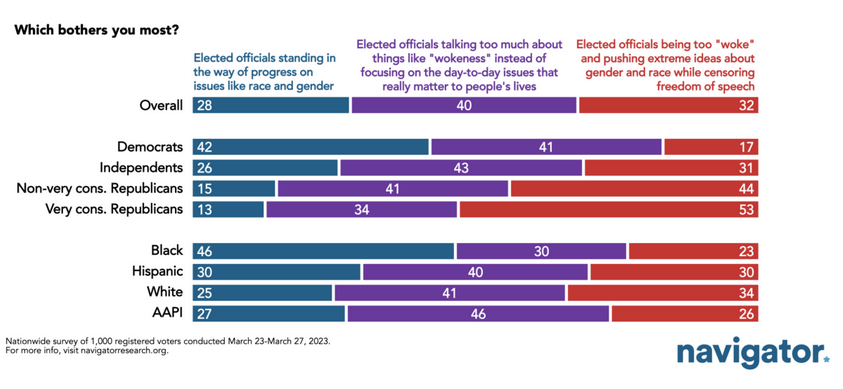
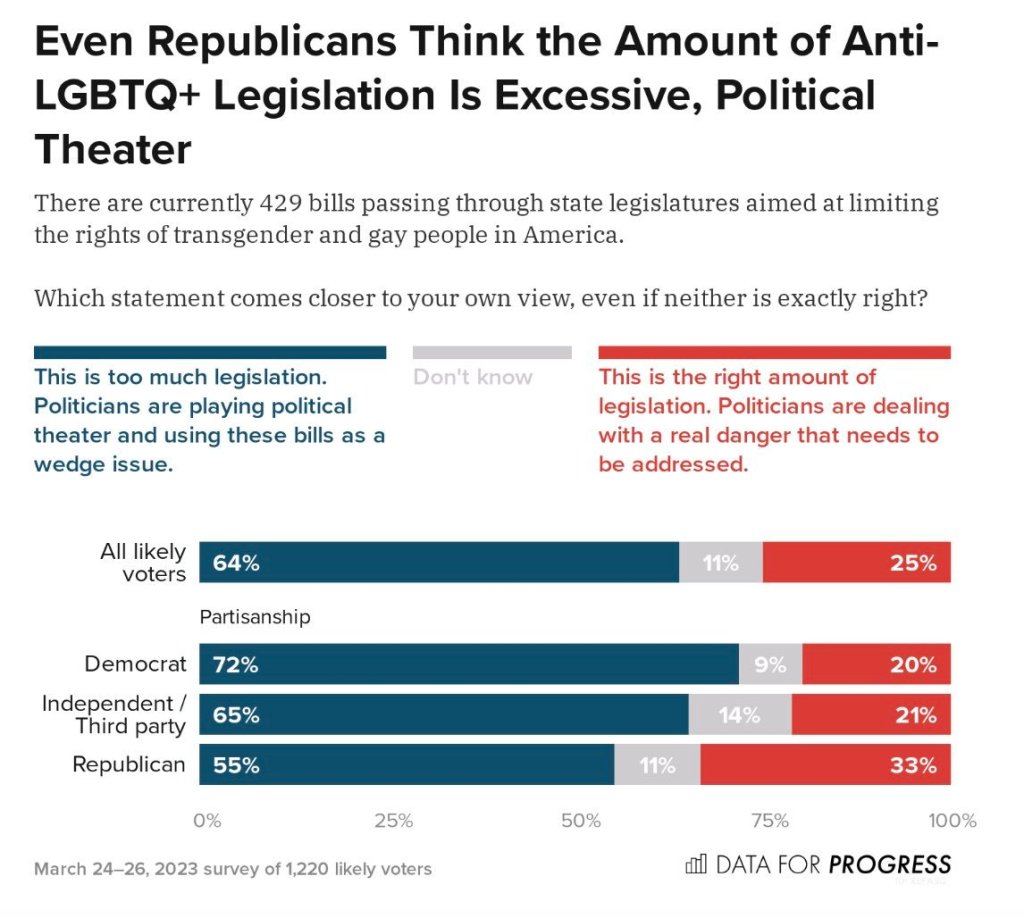
I think the one thing to remind oneself is this: the internet is not the real world and activists don’t necessarily represent the mainstream of the community they’re advocating for. I say this because so much of the rancor and rage out there is fermented by people using the internet as the barometer of what is actually happening in the real world. The Republicans for example have convinced themselves that people like Matt Walsh, Ben Shapiro, Michael Knowles etc. represent the mainstream along with activists who keep keep bringing up the usual nonsense about wokeness and LGBTQ+ getting out of control but then you have polls such as these two (sourced from the following Twitter account):
The end result is that when it came to the midterms the ‘red wave’ never arrived because what they thought were important issues to voters was only important to those who are terminally online with everyone else aka ‘normies’ too busy dealing with taking care of kids, going to work, trying to juggle paying bills, trying to make ends meet with high inflation etc. It is highly unlikely that the ‘normies’ are engaging with the terminally online discourse that the Republicans have convinced themselves represent mainstream America – 13% want abortion completely banned with 87% of Americans sitting somewhere around the middle thus making the Republican shtick of using ‘The Daily Wire’ commentators as sources of ‘insight’ into their voting base appear rather ridiculous given the midterms outcome.
I’ve finally organised my time off in June, from 31 May 2023 to 13 June 2023 I’ll be relaxing at home, looking forward to the WWDC sessions, the keynote and my favourite being the ‘Platforms State of the Union’. For those unfamiliar with WWDC there are two keynotes, there is the keynote in the morning which is for the media, the tech enthusiasts etc. which gives a high level big picture overview with a focus on a small number of key areas which give a general vibe to the public about where their focuses are going forward. The other keynote is called the ‘Platforms State of the Union’ where it it is still very much a high level overview but with more technical details but not as much as say a session which narrowly focuses and dives very deep into that area. For example, in the keynote they’ll talk about how they’ve improved media performance, the ‘Platforms State of the Union’ will talk about how the media frameworks are optimised using xyz technology and then the sessions will go into detail regarding what they did on the backend and how as developers they can take advantage of it.
As expected Apple has released updates to their various platforms including the firmware for the Apple Studio Display – there were many security issues addressed in these updates (link), I noticed a slight improvement in snappiness although I haven’t given Safari 16.4 a good working over but I have a feeling that I’ll install AdGuard, update the filters, visit my favourite streaming website then find myself unindicated with ads, popups etc. that uBlock Origin blocks 100% on Chrome.
System Firmware Version and OS Loader Version upgraded from 8419.80.7 to 8422.100.650 and Wi-Fi firmware upgraded from 20.10.965.13.8.7.131 to 20.96.27.0.8.7.144, there appears to be more DriverKit drivers that have been added and much more. It’ll be interesting to see what is in store for macOS 14 in terms of under the hood changes and what hardware support eventually be dropped as they eventually phase out Intel support in favour of going 100% ARM.
I am looking forward to the upcoming conferences – Google with their Android developer conference then followed by Apple with their WWDC which is normally held the first week of June. It’ll be interesting to see whether iOS 17 will include the required changes to bring it in compliance with the European Union’s Digital Markets Act – allowing side loading of apps and third party app stores along with allowing Google and Firefox (and others) to enable them to use their own web rendering engine with their browser rather than the current situation that they have to use the built in Webkit.
Android 14 beta builds will start appearing from April through to the beginning of June before there is a platform freeze with the focus from that point onwards regarding bug fixes based on feedback from early adopters and developers. Although I have been holding out for some big changes or new features to be announced, I think the focus will be around refinement and probably an announcement regarding removing support for third party cookies in Chrome along with using the Topics API and Privacy Sandbox – it wouldn’t surprise me if we end up seeing maybe a 6-12 month phase out with Topics API and Privacy Sandbox being made available to older versions of Android getting it via a Play Store monthly update in much the same way the new photo picker was made available to older versions of Android.
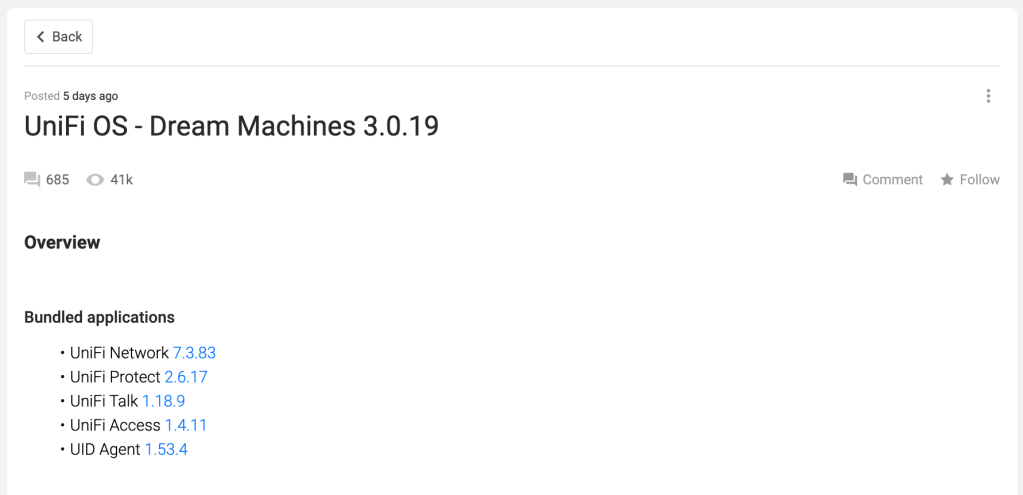
Ubiquiti has released Unifi OS 3.0.19 to the early release channel – it has been a long uphill slog from the 1.x series to the 2.4.x series to now the 2.5.x series then eventually when Unifi OS 3.0.19 it should mean that Unifi OS harmonisation across all the various network devices should mean feature parity.
I am looking forward to the ad blocking feature baked into the router itself – it’ll be interesting to see how it performs when compared to using uBlock origin particularly regarding how many ads it allows through versus website compatibility and whether there are issues when navigating websites with ads that use ad detection to block users from accessing their website. Hopefully the gap between Unifi OS 3.0.19 and Unifi OS 3.1.x series shrinks – the UDM was probably one of my better purchases when it comes to networking equipment vs the years of purchasing consumer grade routers only to find that they’re buggy, unreliable etc.
When it comes to Pixel devices with the latest QPR3 Android 13 beta it appears that not only is VoLTE and VoWIFI is working but also 5G is working as well in New Zealand. As I’ve said in the past, I’m all all good with Google choosing to sell Pixels online only in New Zealand (and shipping them out of an Australian warehouse) due to the small market or even not selling at all in New Zealand but what frustrated me was the lack of support for mobile phone carrier settings in New Zealand. From my point of view it will open up more Android options than the current situation of Samsung, Samsung and Samsung – variety is always good which is one of the reasons why I’m stoked that have my Nothing Phone which has ‘renewed my faith’ in Android.
For me, when it comes to computers I am all the way with Macs but when it comes to phones, I am pretty agostic along with set top boxes, networking equipment etc. For me, I see the Pixel as the ‘iPhone of the Android world’ but given that at the moment the lack of fully support for New Zealand carriers I went with the Nothing Phone. It’ll be interesting to see when the Nothing Phone 2 is released given that the SoC being used will be the Qualcomm Series 8+ Gen 1 – although it would not be the bleeding edge, I think for the vast majority of people it is good enough particularly for those who are drawn to the aesthetics of the Nothing Phone.
How are things in the world of Chrome? I keep giving Safari a try to see whether the issues I experience have been addressed but so far what I see are Safari playing catch up at least as so far as addressing bugs that break compatibility with other browser implementations of standards but looking at the Webextensions API it appears that there is a lot of uphill work yet to be done. A good example of that would be the recent discussion on the Webextensions API meeting minutes regarding user scripts, adding more functionality to the Declarative Net Request to fill in the gaps that many of the third party developers have raised etc. Part of me hopes that Google just get rid of the whole notion of MV3 and instead just focus on evolving rather than making an announcement then suddenly realising after making the announcement that there is a tonne of functionality missing that many extension developers actually need to make their extensions work.
Apple has released the release candidate builds for the soon to be released updates for the various platforms such as macOS, iOS, tvOS, watchOS, homeOS etc which will probably result in them being either released on Tuesday or Wednesday (NZ Time) next week. When they are released I’ll probably do an upgrade but on 7 April (NZ Time) I’ll do a clean install since I have a lot of stuff built up when trying different software – I like to experiment with different web browsers for example as to educate myself with what is out there so then I am knowledgeable enough to provide technical support to customers who ring up. It’ll be interesting to see what security bugs are fixed and what features from the Technical Preview have made their way into Safari. There was chatter about AV1 support in an older technical preview but I hazard to guess that it’ll probably be something that will appear in the next version of Safari being announced at WWDC because I’m sure there is plenty of optimisation that need to take place – the SoCs that Apple are plenty powerful enough to decode but it is more an issue of making sure it is done in the most optimised way possible to preserve battery life as much as possible.
To follow on from my previous blog post, part of being in a political party is to develop policies then advocating those policies to the public – if you’re in opposition then you’re the government in waiting so your job is to convince the public that if you were in government that what you’re advocating are the policies you would pursue if you were in government. When it comes to the government, there job is to not only education the population so that people know what policies there are how they will benefit from it but to also educate potential voters of their track record in government – “if you like the policies then vote for us at the next election.”
So where does the ‘mainstream media’ fit into this? In a well functioning world or at least a world where the media does it’s bare minimum of informing the public but so far what I have seen is the ‘focus on horse race politics’ of who’s in front, who’s behind with next to no time spent dissecting policies and doing a deep dive into the details of what makes x politicians policies different from y politician’s policies. The reason why that is important is because political parties are all about showing their policies in the best light which involves emphasising the good aspects while either downplaying or ignoring altogether the rough edges for example replacing the working for families with a tax free threshold will involve some who will be better off while others maybe worse off depending on the circumstances. The role of the media is to step back and provide an impartial analysis so then voters get a better picture of what is on offer by the different political parties.
Why is it important for the media to do a deep dive? in a well functioning world the media would conduct a deep dive into these policies and look at it from an impartial point of view. Politicians may try to spin the focus by the media should be to go into details, talk about the good, bad and the ugly, the winners and losers from such a policy, the cost of that policy and whether it’ll require tax increases to pay for it, what are the risks in terms of its implementation, the likelihood of it actually getting passed etc. The politicians do the spin, the media are meant to unspin and be the ones who go into detail on what is on offer. The usual complaint is that people aren’t interested in long form interviews or discussions to which I say “Joe Rogan” – he isn’t someone I listen to but given that his podcast goes for sometimes up to 2 1/2 hours yet has millions of listeners so if Joe Rogan can get and retain listeners then there is no reason why a lively discussion about policy with a few jokes and witty remarks can’t get a few million tuning listeners to as a podcast and maybe a cut down 1 hour version for television (40-45 minutes if you exclude ad breaks).
Once again the media is in a frenzy with claims that Trump will be soon be indicted (link) but given how often Teflon Don has been able avoid being prosecuted in the past so I have rather hesitant to pop the champagne cork given past experiences. Assuming it all goes ahead and Trump is charged resulting in him leaving the GOP presidential primaries, will that result in the current candidates toning down their rhetoric in the culture war knowing that Trump and Trumpism are not a factors to worry about or will one of the candidates step into Trump’s position to be the ‘Trump candidate’. Personally, I think the sane Republicans in blue states in positions of governance who are looking on – they should wait it out, allow Trumpism to crash and burn in the election then bring the party to it’s knees so then it gives the ‘adults in the party’ the leverage to go “ok, we tried your childish thing, now it is time for the adults to take back the party” then purge the party of the freedom caucus and take greater control over who runs in which district rather than the current free for all.
Back in New Zealand it will be interesting to see what the election will result – I’ll vote my usual combination of Labour for my local MP and Greens for my party vote (they’re as far left as one can get in terms of being a viable party with representation already in parliament). Let me start off by saying that Labour has been a huge disappointment – rather than focusing on maybe 5 key areas they tried the scattergun approach with the end result being that very little was actually achieved as a result. The other problem is the lack of a big vision of where Labour want to take the country “here is our vision, and here are the 5 policies that are going to get us there” vs what appears to be meandering along, a bit here and a bit here but not overarching coherent strategy to address the myriad of issues that need addressing. What I would like to see is the following:
Full electrification of the New Zealand rail network, standardisation on 25kV and expansion of the rail network: a) Expand the Melling line down to the Kennedy Good Bridge b) Bore a tunnel for both a rail connection as well as a road connection to Wainuiomata which will open up opportunities for further development as well as improving connectivity between Wainuiomata and the Hutt Valley/Wellington. c) Tunnel bore a connection in Auckland from the CBD to the airport and connection to north shore. If there is money and time then replace the Auckland harbour bridge with a tunnel instead. d) Rebuild the long distance passenger service by upgrade the rail track ballast along with investment into depot to depot small goods movement, mixed passenger/small goods for low traffic lines etc. e) Invest into intercity rail in the south island particularly from the north of Christchurch to the heart of Christchurch where a good portion of the development is occurring as well as investment into light rail particularly out the airport with a focus on grade separation along with ‘cut and cover’ where required.
Investment into renewables – focus on making greater use of geothermal particular through using closed loop systems where heat is transferred via a liquid being pumped through a closed loop with a low boiling point to heat water to run a turbine.
Rebuild the ministry of works so that the government has the means by which large scale nation building projects can be executed without constant stopping and starting resulting in the building up of knowledge being lost as teams that completed one project are only on temporary short term contracts rather than long term stable employment where the knowledge can be built and passed down as new employees join and older employees leave or may continue on in a more casual/contractual basis.
Turn Kāinga Ora into the primary provider of rental accomodation by engaging in a massive house building project – that includes replacing existing houses on large sections and subdividing them with efficient dense housing so that more houses can be provided using the existing land holdings that Kāinga Ora already own. The way to decomodify housing is to make it unenticing for it to be an investment – set Kāinga Ora rental prices based on 25% of a single persons income if they’re a couple or 12.5% if they’re a single person living by themselves (maxing out at $500 for a couple, $250 for a single person). Provide enough housing at that price it would drive landlords resulting in house prices going down not to mention the ability to stay long term in public housing results in buyers being able to be more picky. Long story short the masses would rent from Kāinga Ora, the private sector would build houses to own and what little private sector rentals remain would be to cater for niches that Kāinga Ora would cater for aka rich people wanting to lease a luxury home because they don’t want to have their money tied up in a house they’re living in temporarily.
Reform the welfare system so that it encourages rather than punishes people who take the initiative and take a chance with a part time or casual job. a) Completely removal of the stand down period and streamline the process for those who work in seasonal jobs and may find themselves off work for short periods (I worked for a catering company that followed the university calendar resulting in breaks between terms and found I wasn’t eligible for any assistance from social welfare- the problem the business had is that they couldn’t retain staff for that very reason). b) Increase the level at which abatement kicks in – on a solo parents benefit you can earn up to $160 a week before tax before abatement kicks in (link) which works out to be 7 hours per week. Let’s be realistic, how many employers are going to employ someone for 7 hours a week? at minimum the abatement level needs to be doubled which would give someone a realistic chance of getting a casual/part time job when receiving the benefit. c) When means testing ask more questions than just “what is your pre-tax income” because in all due respects asking someone what their pre-tax income is tells you nothing about what the financial situation – the purpose of means testing is to find out how much they’re living off once tax, student loans, maybe fines payment plan etc. are taken off the income. It is also important to ask them what their outgoings are or otherwise you’ll end up in a situation of a person owning a business, running all their costs through the business then paying themselves a small stipend so it makes them eligible not just for assistance but their kids can qualify for student allowance etc. If you asked people what their core essential outgoings are such as rent, electricity, gas, petrol for the car or cost of public transport, groceries etc. then you’d seperate those who genuinely need help vs those who game the system through accounting trickery.
I’m not hopeful that something like the above would happen but if it were to happen then it would immensely improve New Zealand by focusing on some core areas then once addressed then building on it. There was a once in a lifetime opportunity in 2016 to lay out such a bold version for New Zealand but unfortunately that opportunity has been squandered.
It appears that thanks to an accidental leak that the next version of the Nothing Phone will be utilising the Snapdragon 8 Gen 1 – although it is a generation behind the one thing to remember is that only the big vendors have access to the latest generation due to being able to buy up in bulk a large number of units. I don’t think there will be a huge difference between Snapdragon 8 Gen 1 and Gen 2 other than the benchmark enthusiasts. Carl Pei has gotten the old development group back together again so hopefully we’ll see Android 14 making the way onto the Nothing Phone 1 and 2 (I’m assuming that the Nothing Phone 2 will launch before Android 14 stable is released).
Android 14 Developer Preview 2 was released a few days ago (link) but I’d say there will be more details at the Google I/O on 10 May 2023 – it will interesting to see what happens with the big privacy push particularly around third party tracking and cookies in light of the work that Google is doing around Topics API where rather than tracking then forming a profile there is a sandboxed anonymised set of interests that developers can then use regarding what ads should be shown to a particular end user. In a perfect world Apple and Google would standardise on something that both Apple and Google can live with – that can preserve privacy while ensuring that the ads being presented to the user are relevant.
Chrome 111 was released recently and everything is going well – what keeps me on Chrome isn’t just the performance (and the improved memory and power efficiency) but also the third party extension ecosystem. I only have one extension installed and that is uBlock Origin – although Google has been talking about phasing out MV2 in favour of MV3, they’ve kicked the can down the road a few times to now they no longer have a solid date. Long story short, it is easy to make an announcement but it is difficult to stick to it when you make an announcement before talking to all the stakeholders whose extension would no longer work because what is what they depend on MV2 no longer exists in MV3 – the WebExtensions Community Group minutes give a good insight. I think what is going to happen is that they’ll do a piecemeal deprecation of components. IMHO, there is no hurry, take your time and ensure you get it done correctly.
Although I am having some ‘homesickness’ about breaking out of the iCloud/Apple ecosystem I am still enjoying the Nothing Phone, Chrome, Google Workspace etc. so I guess it is the jarring experience of having been using something for over a decade then abruptly changing then finding the experience is disconcerting as one adjusts to the new way of doing things.
Watching the news regarding the SVB, Signature Bank and Silvergate Bank, and once again the right wing are looking to find distractions to move the conversation away from yet another example of Trump era deregulation coming back to bite the public on the backside. Unfortunately in the political world there is a lag between a policy being enacted and for the downstream effects of such a policy to materialise in the real world. It is one of the reasons why I would like to see longer parliamentary terms in New Zealand – move from 3 year terms to maybe 4 or 5 year terms which would encourage more long term planning not to mention giving enough time for voters to see the outcome of the policies so they can then make an assessment whether to vote for said party again.
I’ve moved back to Safari as my main browser (I still keep Chrome around because my work uses Google Workspace – using Chrome integrates me into work so I have access to the saved passwords, bookmarks etc). The bigger decision is moving back to the Apple ecosystem and by that I mean moving back to the iPhone and AppleTV. The first step will be AppleTV because unfortunately the way in which Google has setup their home software is that I cannot access it from my laptop or desktop along with the insistence of Google Home going through Arlo’s own service rather than providing a hub for the security cameras themselves as with the case of Apple and how the AppleTV acts as a hub which in turn allows me to then open the Apple Home application on macOS to be able to check things out. There are also limitations to the Google Home application, for example, it doesn’t inform the end user of the battery life so one cannot keep track of how low the battery is then being able to guesstimate how much time until one needs to recharge it.
Although I love my Nothing Phone the big problem when reviewers review phones, apart from their obsession over the camera, is the ecosystem in which the device is integrated into. In many cases it is the ecosystem that drives adoption forward of a given device and once a customer has a number of devices integrated into that ecosystem then the customer becomes used to the frictionless integration thus anything that ends up breaking that frictionless integration makes the overall experience more jarring.The big question is whether I wait for the iPhone 15 to appear or whether I just go with the iPhone 14 given that the difference isn’t going to be that extraordinary – we’re in the age of refinement and incremental improvements rather than the massive leaps where moving from one generation to another offered giant leaps but these days most people are updating maybe every 3-5 years (probably closer to 4 years for many people).
Regarding the world of politics, I have to admit I am sitting back and watching the whole Fox News, Dominion Voting Systems saga it is interesting seeing how the various high profile names are dealing with it – throwing each other under the bus to absolve themselves of responsibility. What I find particularly interesting is post 2020 election where Fox News called Arizona for Joe Biden saw their view ship move to OAN and NewsMax – then suddenly all the hosts started to change their tune to give the audience what they wanted. Oh to be a fly on the wall and see the discussions taking place, I wonder whether any of the big names were all onboard with maybe pushing the envelop but were concerned with giving ‘the crazies’ a platform resulting in not only Fox News being impact but also themselves given that many have jobs outside of Fox News such as Sean Hannity who has his own radio show.
The reason why I raise this is because if things get a bit spicy then those networks syndicating Sean Hannity’s radio show (along with other hosts that have their own radio shows and podcasts) might be concerned that what is being said on Fox News might make it’s way onto their radio network thus potentially exposing them to trouble some time down the track. This is where I think that maybe some of the big stars may cut their losses and the big question is what is going to happen with Fox News going forward – do they shut down the channel and relaunch a new channel in it’s place with a focus on not repeating the mistake of the past? the reason why I ask is because I think back to people who have gone to the crazy end of town then realising what they had done to then try and back pedal only to find that the audience they lost in their move to the extreme aren’t coming back and those on the extreme will either abandon them by labelling them as a sell out or find people who are willing to go even more extreme.
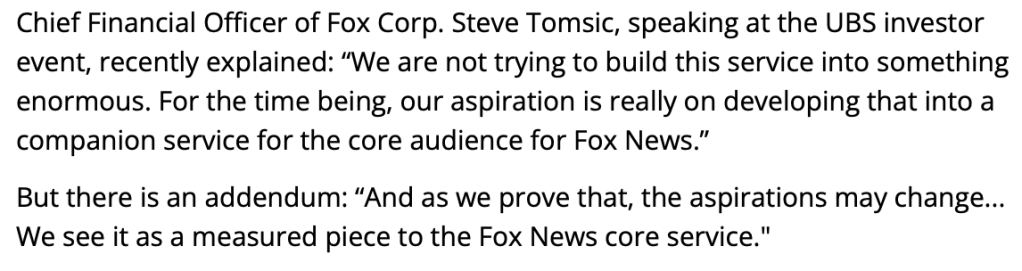
Side note: Although Fox News likes to boast about being number one cable channel but one thing to remember is that the media in the US is very fractured with Fox News as of 2022 having an average view ship size of 1.996 million – the average house hold size is 3.13 and a population of 331 million meaning that there are around 100 million households meaning Fox News gets around 2% of households watching their channel. When you break down the numbers it isn’t as impressive as the marketing make it out to be. That doesn’t even touch on the fact that the demographics are certainly not on their side with Fox News (their audience skews towards older demographics) along with not giving numbers on the number of subscribers using Fox Nation – their service that is apparently trying to win over Gen Y and Z. If their numbers were great then it would make sense that they would boast about it at almost every opportunity but from what it appears the fact that the only data has been guesses by analysts and the downplaying it as a ‘companion service’ (link) (I’m using a Google Cache link because the original website forces you to create an account):
Fox News had a business model that worked for 26 years but maybe it is past it’s ‘use by date’ with a core demographic dying off and the new generations coming through that are less and less socially conservative and reactionary resulting in the question – what does Fox News do? where trotting out the ‘socialism’ and ‘communism’ boogyman might get the low information voters and those raised during the Red Scare but hardly an audience size that advertisers are willing to spend money targeting.
I was reading through the improvements that are coming to the various web browsers in February in terms of web based technologies (link) and at the bottom it talks about the big list ot changes coming to Safari. Being the cynic that I am I brushed it off and went straight to the source to see what changes are going to come in Safari 16.4 (link). The laundry list of issues that have been resolved are huge particularly in the area of the Webextensions API which should hopefully make content blocking a lot more reliable on Safari (when using AdGuard) when compared to the almost ‘solid as a rock’ robustness that uBlock Origin has on Chrome.
There is still a lot of work being done on declarativeNetRequest – although there are rumours of a date that Google will start pushing MV3 to replace MV2 I believe it’ll be 1-2 years before anything happens. The best way to keep track on what is happening is check out github, the same answer I give when people wondering what is happening behind the scenes at Apple, check out the outsource projects because you’ll get a good insight regarding the direction being taken by developers. For example, one of the big features in regards to the development of MV3 is the User Scripts API where a proposal is being made but that’ll involve many discussions between the many stakeholders – both the developers of web browsers along with the third party developers that’ll leverage the User Scripts API as they’ll want to ensure that what is being developed is fit for purpose.
The Chromecast with Google TV although it is incredibly sluggish when compared Apple TV. I really cannot work out the psychology of Google when they conclude that what was holding Chromecast with Google TV back from wider adoption wasn’t the pathetically small number of countries they launched it in but rather it not being cheap enough. Side note, I would be more than happy to pay an extra $20 to have a better SoC inside with more storage and memory and I hazard to guess that availability is a greater driving factor whether a given set top box is purchases when one considers how ubiquitous Apple TV’s are to purchase – it was launched 30 September 2020 however it didn’t arrive in New Zealand until June 2022 with the Pixel Phone still not here even though New Zealand and Australia (which has the Pixel) are treated as a single marketplace yet New Zealand doesn’t appear to be a market Google is interested in catering for. It will be interesting to see whether the Chromecast with Google TV will receive the Android TV 13 upgrade or whether we’ll see it die on the vine.
Personally, I could see AV1 video support appearing soon in iOS and macOS given that it has already been added to the Web CODECs in the Technology Preview release a few weeks ago (then removed from the public blog page). Even if there isn’t hardware accelerated built into the Apple SoCs I’m sure there is enough grunt to to be able to decode it given that there are already phones running less powerful SoCs that are able to decode an AV1 stream from YouTube via the YouTube app and the Chrome web browser.
Jack Dorsey is now pushing out a public beta for their BlueSky (link) – for me it is a solution to a problem that either doesn’t exist or already being addressed. He talks about the AT Protocol as the backbone to BlueSky but why not work together on ActivityPub instead of reinventing the wheel? are their shortcomings or flaws in ActivityPub? I don’t know since I’m not an expert on protocols but something tells me that given that ActivityPub is an open source project then I’m sure they would be more than happy to take on any contributions that could be made to make the protocol even better. It reminds me of this cartoon (link) and very much the numerous open source projects where the effort is split amongst competing projects rather than putting egos aside in favour of working on something that’ll have more success because the effort isn’t being split in different directions.



You must be logged in to post a comment.