Well, I see that AdGuard Safari Extension was updated in the last couple of days from 1.11.18 to 1.11.19 – the update includes updating the scriptlets library to 1.11.16 which adds new features and fixes existing bugs (link). I’ve still kept my custom user filters that I use rather than relying on the allow list which doesn’t always work reliably (websites broken such as YouTube even though the allow list should disable content blocking) – everything is working as it should although I am looking forward to the much rumoured move away from it being an electron application to it being native – maybe they’re going to make use of catalyst and make their iOS one available on macOS.
Just watching a clip from Jack Tame’s Q+A show:
I find it interesting how there is so much talk about the ‘nice to haves’ but never go into detail what they mean – for example during the council budget process in Auckland there was a debate about whether the council should continue funding the local Citizens Advice Bureau (CAB), are libraries considered nice to have? I guess this is going to be one of those situations where people proclaim “they need to stop wasting money” only to end up getting a copy of the council budget and realise that the ‘waste’ that can be found is close to a rounding error when one considers the size of the budget. Once again we have the National Party led government believing that engaging in bellicose rhetoric is an example of leadership in much the same way that the former health minister believed that yelling at the healthcare system “be more efficient’ will magically result in more being done with less.
There was a recent transportation announcement and they used the same ‘back to basics’ rhetoric when it came to roading – cutting spending for biking, walking and public transport while implying that such investments are liberal indulgences rather than ‘serious transportation infrastructure’. The petrol tax isn’t just about paying for the infrastructure it is also there (along with carbon tax) to pay the cost of offsetting the negative externalities of vehicles on the road – the planning around public transport, biking and walking is the attempt to offset negative externalities including meeting our climate change goals that we agreed to at the last global submit New Zealand attended.
I’ve been sick for the last couple of days then add to that the ‘winter blues’ I’m pushing myself forward – it’s difficult not to fall into slump and once in that slump trying to pull oneself out of it. We’ve had some crappy weather and it is difficult to keep being motivated with work but I guess if I keep focused on the end of the year – time off from work, maybe early next year I might go for a holiday to Australia for a couple of days, that’ll keep me focused on something to I am motivated to keep moving forward.
Just reading an article over on Bloomberg (link) When I saw Apple getting into original content I was sceptical regarding the cost vs the amount of money they would bring in directly through subscriptions and indirectly in the form other sales along side subscriptions. I think the big mistake is their failure to buy out TimeWarnerDiscovery (or whatever it is called today) when they had the chance then fold the whole thing into Apple television and bump up the price. They would have gained a massive back catalogue of content including classic movies through to cartoons not to mention the chance of turning CNN around so that the domestic version of CNN would resemble that of their international service aka a serious news channel rather than indulging in something resembling a yelling match.
I’m giving Chrome a go along side Firefox and in my experience so far, uBlock Origin Lite is pretty good when compared to AdGuard which still allows things through that uBlock Origin does a good job stopping – yeah, I could submit a bug report but most of the time it’s like the comic of the suggestion box that is actually just a shredder. I’d be more than happy to pay for an updated and improved AdGuard Safari Extension in much the same way I’ve already bought AdGuard for iOS – AdGuard that addressed the issues I have along with being native code rather than running as an Electron application would make me more than happy to pay for it.
I’ve been following the WECG meeting minutes recently a request for functionality to be added to the scripting API (link) that was put forward by one of the uBlock origin developers – what I hope is that the WECG take on board this (and other requests by content blocking developers) rather than the usual “do the bare minimum and hope the developer gives up” approach that so many involved in the WECG take (see Apple and their half hearted attempt to implement the Webextensions API to bring Safari into compatibility with Firefox and Chrome (just look at the compatibility matrix for the scripting API (link)) or just the general disinterest in actually supporting improvements based on the the minutes written where the Apple appear to want to be doing something other than being at the meeting).
Ok, I was watching the Sunday (18 August US time) episode of Meet the Press and what frustrates me was the way in which the issue of ‘banning price gouging’ was being reported – drawing the conclusion that ‘banning price gouging’ equals price controls even though nothing is mentioned regarding price controls. It also completely ignores the fact that 39 out of the 50 states have ‘anti-price gouging’ laws on the books that have been made use of during times of natural disasters. Not to long ago a state prosecuted retailers (the name of the state escapes me since it was a few years ago) engaging in price gouging before a natural disaster as people were stocking up on bottled water, food that could be stored without refridgeration etc.
To those complaining that you should ‘let the market work’ – why? if there is a limited amount of something there is another option, limit the number that one can buy of a given product to ensure that there is enough for everyone. Go into the local supermarket in New Zealand and it isn’t uncommon for a supermarket to run a special on soft drink but then limit it to 6 bottles per person or another example would be the shortage of potatoes which flowed through to a shortage of oven fries – again, the supermarket limits it to maybe 2 bags per customer.
Side note: Dear marketing people, what you call ‘cold outreach campaigns’ is spam so stop trying to dress it up as if you were doing something respectable.
I’ve decided to give Chrome another go to see how MV3 fares when compared to MV2 in Firefox and the bespoke content blocking API that Apple uses in Safari (they are adding declarative net request but still trails in functionality when compared to the implementation on Chrome or Firefox). I have to prefix this by stating that I don’t expect content blockers to be 100% perfect but as but long as the visual pollution is kept to a minimum then I’m happy to take a win when I get one. What I hope is that we’ll see the declarative net request be developed further – part of that hope is on the basis that Google probably wanted to get the move over and done with so once they’re over that big shift it is possible to make tweaks afterwards to improve things in much the same way that when the ACA (Affordable Care Act) was passed it wasn’t perfect but has improved as tweaks and changes have been made. What I can say in defence of MV3 and the declarative net request – it is very fast, very light weight and you definitely notice the difference when using a MV3 extension on Chrome and I do hope that as they improve the DNR along with other APIs that the performance will remain.
The launch of the Google TV Streamer has gotten me pretty excited about the future of the Android TV platform particularly when one considers it is now a full fledged matter/threads hub for ones myriad of gizmos one has around the house. It is one of the things that has disappointed me is Google convincing themselves that the reason why they had a low uptake of the first Chromecast with Google TV was due to price – lets get one thing straight, US$99.95 is a bargain and it isn’t as though you’re buying a new Google TV Streamer every year so assuming you keep it for 4 years then that works out to be $25 per year or around 45 cents per week. The reason why Chromecast with Google TV sales were underwhelming is that it took you too long to make it available outside of the US and then to add insult to injury you launched something that was woefully under powered – a slow SoC, hardly any memory and anemic storage not to mention the lack of regular software updates when compared to the monthly updates the Pixel phone range received.
I’m having a look at getting some new security cameraes for my place because at the moment I have some Arlo cameras but the problem is that I need to keep an eye on their power and recharging batteries. What I’d prefer to do would be to replace those cameras with ones that can be powered/networked using PoE which avoids having to worry about recharging batteries. I am tempted to get the Google Nest given how it all integrates together – it’s a bit on the pricy side but the benefit is that everything integrates together well not to mention the ability to hook it up to power with 10 metre cables that can be bought from the Google Store online.
Weekends go so quickly – I wish I had a three day weekend because the first day off one is recovering from work which only leaves one day to actually do something. I’m still deciding whether I should go into the office or work from home – if I go into work I’ll have to take my scooter because the train is currently being replaced with a bus service but the problem with that is that they never arrive on time meaning it is more thank likely I’ll end up at work late.
I’ve just had a quick browse of the Mozilla downloads section and it appears that Firefox 129.0 is present before the official release tomorrow (7 August NZ time) – I’ve updated to it and everything is working great. Every release so far has resulted in an improvement in speed and responsiveness. There appears to be regular benchmarks being done on multiple platforms to narrow down performance regressions as well as comparisons with other leading browsers to see where improvements can be made (link).
There has been an interesting development in the Google DOJ case (link) resulting in concerns about how it will impact Firefox. I think what you’re going to see is that there will won’t be upfront payments but browser vendors will receive money from Google each time a user makes use of Google except it won’t be on the basis of whether it is setup as the the default search engine. The other thing to keep in mind is that Google makes open source community contributions (money and man power) so what you may see are regular donations to the Mozilla Foundation to maintain good public relations of being a positive open source citizen.
I’ve been running Firefox for a while (recently updated to 128.0.3) but every time I update my version of macOS I like to give Safari another try, to see whether things have improved and what bugs have been fixed – I guess I have an optimistic outlook on life where I hope that maybe as Safari improves and AdGuard improves will reach parity with the experience I get with Firefox and uBlock Origin can be reached.
Oh, and I checked to find out why Skype web application comes up with a scary message about ‘reduced functionality’ aka partial support for calling. Given that Skype these days is pretty much irrelevant (I only keep my account around to keep in contact with a friend overseas) I don’t think much is lost given that I only use it for text chatting. I’m hoping that Teams will eventually replace it – it just feels a lot more streamlined, less UI bloat etc.
uBlock Origin 1.59 has been released and is now available through the Firefox extension store – I’ve updated to it. Every release it just keeps getting better – faster, more responsive, dealing with squashing unwanted content.
Regarding the move to MV3 by Chrome, I think what we’re going to start seeing are those who held out until the very end believing that Google wouldn’t follow through with it just as in the past where they made an announcement onto the push back moving to MV3. I think the other reason why many are holding off is the belief that maybe it won’t be so bad – that’s until they realise that filter updates for content blocking has to go through the arduous process of being submitted to the extension store rather than allowing the filters to be downloaded like they can now.
Why is that a hassle? because in the area of creating filters for content blocking it is a game of cat and mouse – always trying quickly update filters as quickly as a web developer has worked around it. The net result of the new way of doing things with MV3? days if not a week or more where users will be inundated with crap that their content blocker cannot block because the filter updates as always lagging behind the speed in which web developers move at.
I don’t think Chrome’s market share will be collapse but I do see tech enthusiasts and technically inclined people moving resulting maybe at max 20% of the desktop user space using Firefox but ultimately if that is reached then at that sized it does keep the big players honest as you cannot simply ignore 20% of users out there. I really do wish people would learn from history because Chrome is slowly turning into the Internet Explorer of today – not on the basis of the technical issues but more the inertia that has built up as Chrome’s dominance becomes more embedded, it becomes the first thing people down load the moment they buy themselves a new computer then come home to set it up.
Apple has released updates to all their platforms today and part of that involves a huge number of security fixes that came through (link) with quite a few updates for Webkit and Safari. On my iPhone 15 Pro Max the modem firmware was updated from 1.60.02 to 1.70.02 along with the firmware of both Macs being updated to 10151.140.19 (I forgot to write down the old version). With how stable things are with macOS I am wondering whether I should wait for the x.1 release of the next versions of Apple’s platforms…but knowing me I’ll want to update to the next version as soon as possible to see the improvements Apple has made to Webkit in terms of conformance to web standards along with fixing up bugs in their implementation of those standards.
There has been a slight performance boost – everything thing feels a bit snappier even tvOS feels a bit more snappy. I have been looking at getting myself two HomePod for stereo sound to replace my existing speakers hooked up to my Mac Studio directly. The benefit of the HomePod is the ability to stream from my Mac Studio or from my Apple TV so then I can have decent sound quality when watching a movie. It is NZ$529 but it isn’t as though it is something that you buy every year I’ve got a few more things I’m going to look at but we’ll see how things go.
Regarding Kamala Harris, the way in which reproductive health is being framed in terms of freedom is exactly how I’d be doing it if I was in her position – do you want to make that decision or do you believe that decision should be made by politicians? I hazard to guess when you frame it in that way that you may even get people who maybe anti-abortion (in terms of their personal moral position) but are also equally opposed to the very idea of the government coming into private lives of women and telling them what they can and cannot do with their own body.
When it comes to the economy and inflation I do hope that Kamala pushes back the narrative that the Republicans keep putting out that they’re ‘good with the economy’ (and how Biden apparently caused the information problem even though it was the Republicans who injected $7.5 trillion into the economy and ran a massive budget deficit) when for 4 years all Trump did was talk and talk and talk and talk and talk and talk *deep breath* and talk and talk but never delivered – he was a big talker but then again the American public were warned but they decided to ignore those warnings just as Brexit voters labelled anyone pointing out issues as ‘project fear’ are now dealing with the consequences of their devision.
I have finally uploaded all my photos – I was going to use the Google Photos but I found it easier to share it using Apple Photos since I have everything integrated into the Apple ecosystem – I’ve now got 2TB on iCloud so I might as well use it. I’ve got two albums – none of them have photos of me since I’m taking the photo or if someone else is I prefer not to be photoed.
Edit 30/10/24: I’ve taken the photos down because I’ve been having some technical issues.
Firefox 128.0.2 has been released (link) – a minor update that fixed some annoying bugs. I haven’t noticed anything major, it’s as reliable as always. The one thing I did notice which I like is how when using Google Chat the icon on the tab has a red dot when someone has replied back to you which for strange some reason it doesn’t occur on Safari. I’m also enjoying the super content blocking experience that uBlock Origin affords due to Firefox maintaining MV2 API compatibility. Although Firefox doesn’t run natively on the iPhone the truth be known is that I do most of my ‘web surfing’ on my laptop or desktop where as with my mobile I’m primarily using apps such as the Reddit app or the RNZ app etc.
There are rumours of Google launching the Pixel 9, Pixel Watch 3, Pixel buds pro 2 along with a replacement for the Chromecast with Google TV with the rumoured ‘Google TV Streamer (link) – let’s hope that they don’t do something stupid like launch the product in only one country the act surprised their sales aren’t good then convince themselves that it is the price not the lack of availability being the cause of the poor sales. It reminds me of what a former programmer who worked for Microsoft said about the rise of Microsoft Office – the competition was fragmented and made a series of bad decisions rather than Microsoft Office being the outstanding technological superior product. I can’t help but get the feeling that in the technology space the winners end up getting there because the organisations offering alternatives are so dysfunctional resulting in many companies being their own worse enemy.
Just before I start I should put my cards on the table regarding where I am coming from politically – I sit on the left economically and socially I’m a libertarian so for someone like me Bernie Sanders is closer to where I sit politically but that being said I’m realistic. I understand that there is a fine line between what you want vs what is possible politically so it isn’t always possible to get ones ideal candidate so one supports someone close enough to that. In the case of Joe Biden I expected him to be yet another Obama like centrist but what happened in reality is that he ended up being a lot more centre left than most people had expected – Inflation Reduction Act, CHIPS and Science Act, Infrastructure Investment and Jobs Act not to mention the many executive actions such as increasing the minimum wage for federal contractors (Executive Order 14026) along with many others.
The question is with the upcoming election isn’t about disagreeing with Joe Biden’s policies because I would say the vast vast majority of Democrats and voters in general support his policies, the problem is about the ability to go out on a campaign trail and not only defend the policies but to also weave a narrative of where the democratic presidential candidate would like to take the country in the next four years. The problem is that if you have a presidential candidate who are unable to push back against the right wing BS vortex coming out of the Republicans then it won’t matter how good your record in terms of policies is if it you’re unable to articulate a robust defence when Trump and his sycophants start fire hosing their lies through the media.
I’ve been biting my tongue but I might as well put this out there – Joe Biden should have, before the Democratic primary season started, announced that he would be a one term president, that he would like to see a new generation come through (as noted by Mitt Romney when he said he would not seek re-election for the senate), said that he would endorse Kamala Harris but also say that the Democratic party process needs to be robust so that the members of the Democratic Party are united by the presidential candidate representing the Democratic Party. With that being said, when the rumours started my guess was that if he were going to step down it would be after the Republican Party convention.
Oh, and on a side note Republicans are throwing around threats of running off the court – clue to the clueless young Mikey Johnson, a political party is a private organisation, how and who the party chooses to run for which political position is an internal party matter along with what happens if the nominee steps down and as a result needs to be replaced. If in a party constitution says that to be the presidential candidate you have to participate in a punch up for 20 minutes and whoever is standing at the end is the nominee then the is the process the party has collectively decided to be the process – once again, meaning the state has no say in say in that process. Then again this goes into the large issue I have with politics in the United States – the State should not be running the primaries, the only thing the state should be doing is registering parties, candidates and running the general election.
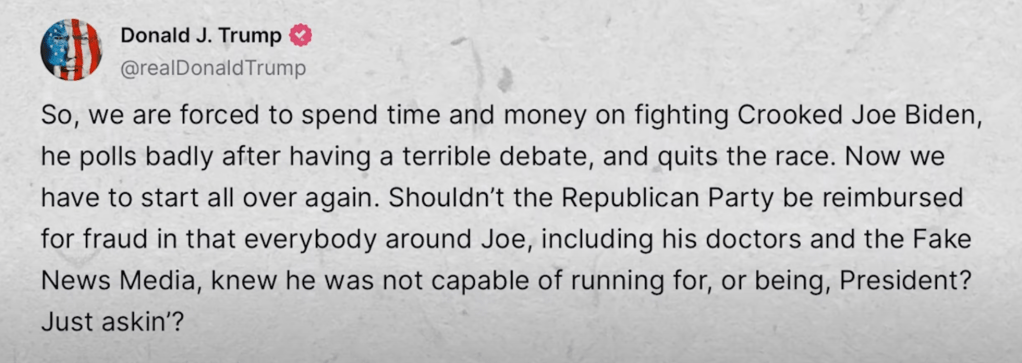
Oh, and something even more funny was the post on ‘Truth Social’ by Donald Trump (obtained from the video where the issue was discussed over at Brian Tyler Cohen (link):
So it is the Democrats fault that you orientated all your messaging around a single person rather than policy? If you were smart you would have made your message something along the lines of “regardless of whether it is Joe Biden, Kamala Harris or anyone else, they’ll be all heading in the same direction which we believe is the wrong direction for America…” but then again that would require that the Republican Party isn’t run by the local brain trust. Once again Republicans playing the victim as they feel the consequences of the decisions they have made.
Regarding her running mate, I personally think that someone like Pete Buttigieg or Katie Porter because the risk of taking a governor from a state where the Democrats have a thin majority may cause more problems long term. In the case of Pete Buttigieg, he’s moderate, middle of the road the ability to go onto Fox News and push back against the avalanche of BS that the right wing media outlet put out there. I also think that he represents a generational change with Kamala Harris representing generation X and Pete Buttigieg representing the millennials – the Republicans representing the past, the Democrats representing the future. Katie Porter has a great skill at breaking down complex issues, pointing out Republican nonsense for what it is etc. Both Pete Buttigieg and Katie Porter would be great for that position – let’s hope that Kamala learns from the mistake Hillary Clinton made when she chose a relatively unknown person for vice president.
The other part is how will be how Kamala positions herself – Republicans are running on claims of a rising crime rate and how Democrats are supposedly soft on crime (see Republican references to New York and California) so Kamala could play her card as a prosecutor, that when people broke the law the held them accountable. The question is, if Kamala does lean into her prosecutor experience does the left and progressives in the Democratic Party throw a temper tantrum and walk off in a fit, “I’m not going to vote for Kamala the Cop” as if some how threatening not to vote is going to magically change everything just to meet their unrealistic demands. What I hope is that the left and progressives aren’t short sighted and learnt from the 2016 fiasco where the same people claimed that fear about a conservative majority picked by the Federalist Society overturning Roe vs Wade was a scare campaign by the liberal elite – funny how those who claimed it was a ‘scare campaign’ suddenly disappeared off Twitter when Roe vs Wade was actually overturned.
Oh, and to add more craziness to the mix, Republicans had a melt down because Mike Pence said something very normal (link) regarding Joe Biden deciding not to run for a second term. It truly is amazing how, with the display of shear lunacy that there are ‘undecided voters’ when the Republicans have lost the plot entirely. Expect the Kamala Harris to drive the right wing crazier now that there is a young articulate candidate at the top of the ticket who push back on Republican nonsense without fumbling it.



You must be logged in to post a comment.